Civilization Scale Computing — 01

Scaling the next era of computing

Beyond the Bit: What Comes After the Individual?

For eighty years, the bit has helped us compute, connect, and scale. Now we are exploring systems that think, entangle, move, and fluctuate. What might become possible when these richer forms of computation work together—and what new problems could we solve?

Explore the four frontiers
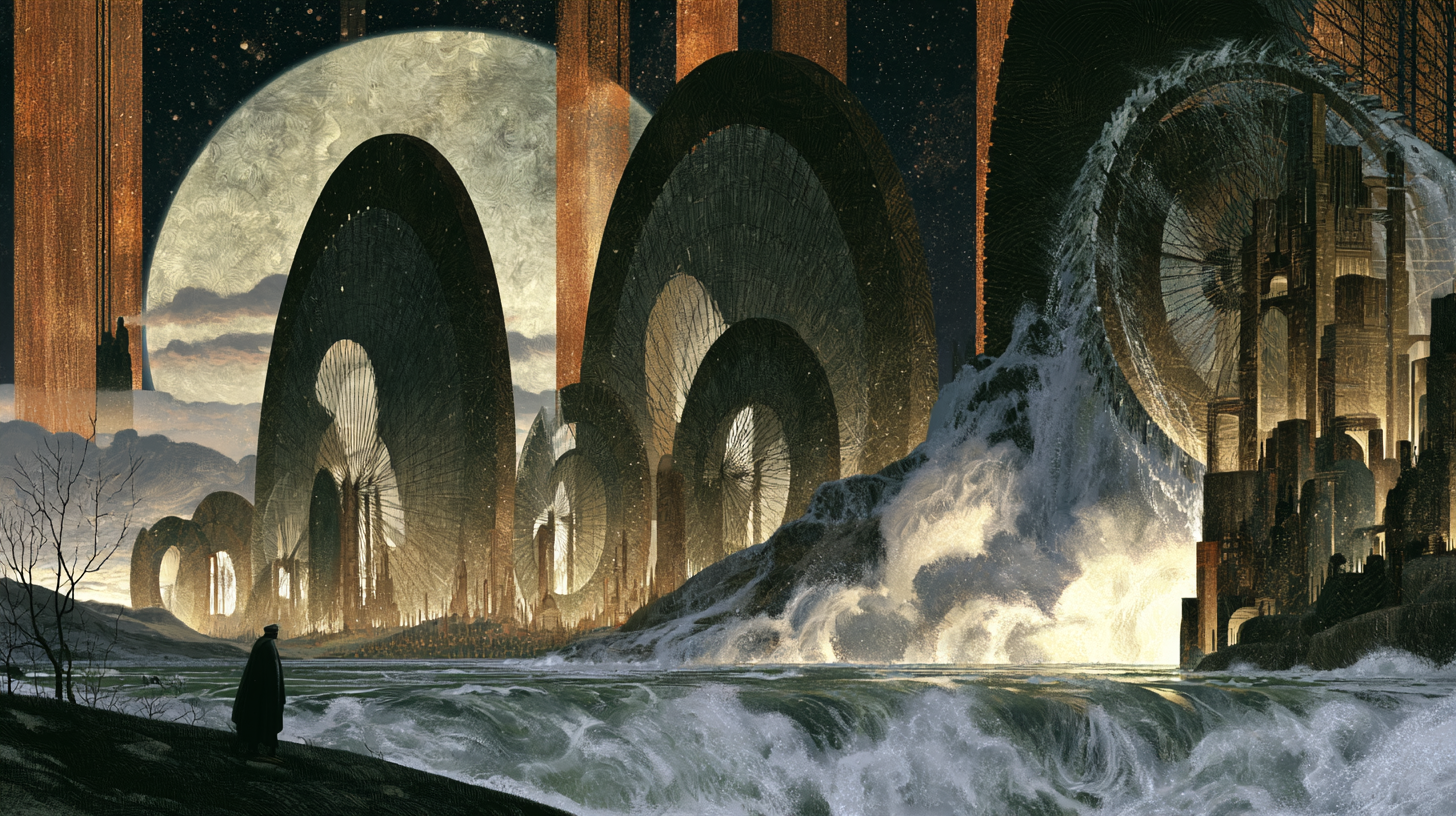
Tiny travellers approach a suspended settlement among monumental arches
Plate IA world larger than its inhabitants
01 / 05

Slide 1 of 5: The central thesis

The larger questionWhy?

Toward Civilization-Scale Computing.

For eighty years, we've made extraordinary progress by computing with bits. We've made machines faster, connected them, and learned to scale computation across the planet.

Yet some of the problems that matter most to humanity—discovering new drugs and materials, predicting weather, understanding biological systems—still challenge the limits of what we can compute.

Civilization-Scale Computing is an ambition to change that.

It means extending computation beyond individual machines, eventually across planetary and perhaps interplanetary scales. But scale alone isn't the point.

The goal is to expand what humanity can understand and solve, and to ensure those capabilities benefit the civilizations that create them.

Four frontiers01—04

Four frontiers.
One theory of scale.

Computing has scaled in three ways: algorithmically, through better methods; vertically, through more powerful machines; and horizontally, by connecting machines into larger systems.

Networks made that third dimension possible for classical computing. But the endpoints are changing. They think, entangle, move, and fluctuate.

Each frontier explores a different form of computation. Each raises the same larger question: what does it take to scale beyond the individual node?

Computing has scaled algorithmically through better methods, vertically through more capable machines, and horizontally through networks that make multiple machines work as one. That third axis now grows more demanding: the endpoints can think, entangle, move, and fluctuate. These four frontiers ask what it takes to coordinate richer forms of computation beyond one node.


The deeper questionBeyond transport

Beyond the individual node.

Connecting machines was one of computing's great breakthroughs. It let us distribute information, coordinate work, and build systems far more capable than any individual computer.

But connecting the next generation of computing systems presents different challenges.

Intelligent agents must share meaning and intent. Quantum systems must establish entanglement across distance. Physical computing systems must preserve useful dynamics when coupled. Embodied intelligence must coordinate perception and action in a changing world.

These are not simply problems of moving information. They require new approaches to distributed systems—across networking, protocols, state, synchronization, and coordination.

Every distributed system must answer a fundamental question: what state must survive the boundary?

A continuing record — 05

Recent activity.

Following the science, the experiments, and the conversations that may change how we compute together.

Collective

From connectivity to cognition

Quantum

Building beyond the individual processor

Physical AI

Alignment in space and time

Boltzmann

Computing with fluctuations and correlations

↑